By Rob Larson
This article was originally published by Truthout
The recent US-China trade truce may hold, but Trump’s constant policy swerves make industrial peace unlikely.
U.S. workers as a whole have endured a lot of losses in the class war. Globally-mobile companies have deserted communities with unionized workforces, successive administrations raised up oligarchs by slashing taxes on the rich, a major epidemic put the country on edge, and landlords are using technology to collude on raising rents more rapidly.
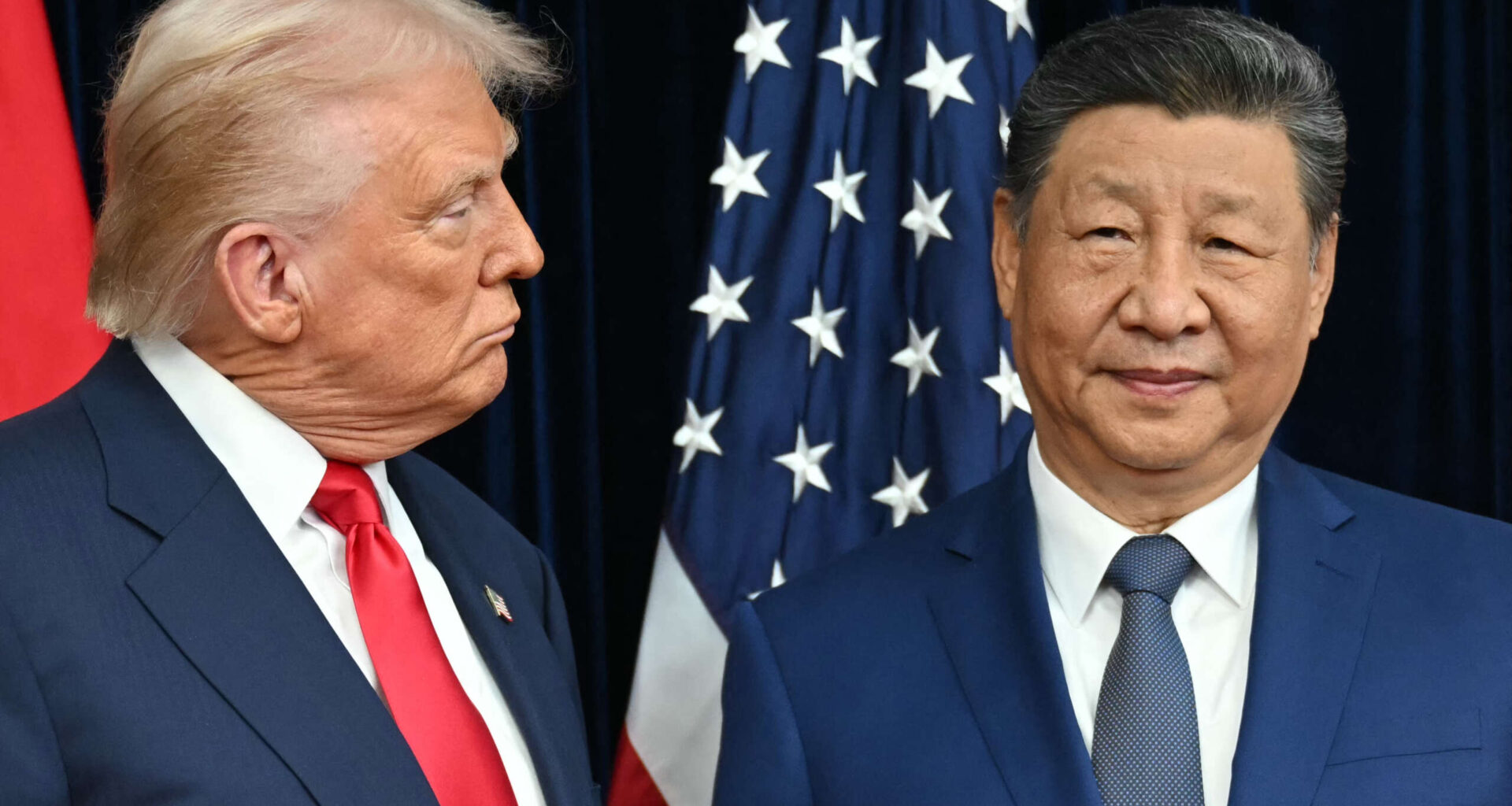
But all this conventional class war is now joined by a trade war — an international conflict over trade barriers like import taxes. Trump’s tariff campaign has been undertaken with a goal of re-shoring outsourced U.S. industry after years of corporate globalization, which firms have carried on under the investment provisions of trade treaties. The tremendous scale of these moves, their baffling and shambolic rollout, and retaliation by foreign powers are just the newest trials of the American working class. And while a recent deal between the U.S. and China — Trump’s most prominent antagonist in such a trade war — offers some hope that the worst effects of such a war could be easing, any agreement with the constantly vacillating Trump is a thaw at best, not a true peace.
Threat Inflation
Tariffs are a tax paid by importers bringing foreign commodities into the United States. They are definitely not, as the Dear Leader has claimed, a tax on foreign countries. Tariff taxes are paid by the importing company that usually produces and/or sells the commodity, like Apple when it brings Chinese-assembled iPhones into U.S. ports.
The importers may trim their profit margins (as the auto industry has done) to pay some of the import duty, but many companies will simply increase prices paid by consumers. These higher prices for imports don’t attract consumers, who then buy domestic goods made in the home country, if they are available. This, of course, is a goal of protectionism — to shelter domestic manufacturers from imported goods and services. This creates captive demand for domestic industry, which is then able to grow and gain the scale and skill needed to satisfy the domestic demand with less competition from foreign capital.
Trump himself claims his tariffs are justified by our trade deficits with other nations, apparently viewing any such deficit as proof of these countries benefiting from U.S. offshoring, and has openly celebrated that foreign goods will cost more. Despite acknowledging this impact, Trump has strongly resisted the idea that the higher prices deliberately sought by tariffs will aggravate inflation, despite imports being 14 percent of GDP. Inflation is still a painful sore point for many Americans after the last punishing wave, due to the 2022 COVID re-openings and the spike in energy prices caused by the Russo-Ukrainian War.
But it should be understood that trade deficits for the U.S. are trade surpluses for countries like China and Japan, which often take the proceeds and invest large flows of capital back into the U.S. Trade partners invest their large net earnings in Treasury bonds, U.S. real estate, and other sectors. Interest rates in the U.S. are lower than they would be otherwise due to these capital inflows, as they add to the supply of investible capital in the country.
The scale of resulting inflation will depend on the breadth and depth of the tariffs; because Trump is a shallow thinker and impulsive decision-maker, it remains unclear where average tariffs will settle. Tariffs on goods from China, our largest trading partner, were 10 percent on February 1, then 20 percent on March 1, then 54 percent on April 2, then an astronomical 145 percent on April 9, then 30 percent again on June 11, but now 47 percent on average across various products. China has mirrored the U.S. with similar tariffs through this period. The main U.S. allies are now subject to large trade taxes, with 15 percent for European exports and for most Japanese goods, with higher rates on materials and cars. At the same time, huge tariffs of 50 percent have been imposed on many goods from Brazil and India in retaliation for those countries’ domestic political decisions, without any regard for economic policy. The cumulative potential for stubborn inflation is clearly real.
Stag Party
Today’s extensive border-crossing supply chains, built up over decades of globalization, will likely be at least somewhat snarled by whatever exact tariff regime is in place when the dust settles. Modern production systems often cross international borders as freely as borders between U.S. states, and having to apply tariff taxes to each step for all the parts of a complete product, along with the paperwork, will likely work an ugly effect. Car and truck parts made in the U.S. are sent to Mexico to turn into systems like the chassis or engine, returned to the U.S. for further work, then shipped back to Mexico for final assembly. Prices are liable to ultimately increase for many goods, to make importers whole or to limit profit reductions, contributing to inflation. But we may also see widespread layoffs due to the combined effects of the new trade barriers, significant retaliation by trading partners, and the constant policy shifts which create uncertainty for investors. These will slow economic growth to the point of stagnation and possibly recession.
“Stagflation” is the term for this ugly combination of recession and inflation, a loathsome condition last seen during the 1970s, when government spending on the Vietnam War collided with an oil embargo by the newly-formed Organization of the Petroleum Exporting Countries (OPEC) against the West over its support for Israel in the 1973 Israel-Arab war. High energy prices fed into prices for all goods, adding to already high price pressures. But the productivity shock also caused a recession, when the economy shrinks instead of growing.
Even with the largest “reciprocal” tariffs on the rest of the world suspended for now, a number of economists, including at the Federal Reserve, have argued that the constant policy uncertainty and the major shock to consumer, executive and investor confidence could do more damage to the economy than the tariffs. A Pew survey found 52 percent of Americans thought the tariffs would have a bad effect on the U.S. economy, and trade association CEOs say the baffling swirl of contradictory tariff news is “undermining long-term investment and growth,” language usually reserved for policies that attempt to ameliorate inequality or fund public goods (what the right often maligns as “socialism”). Falling consumer and investor sentiment, if sustained, will themselves have recessionary effects.
Further, the potential combination of recession, weak growth, and inflation means the Fed can’t easily turn to its usual tool: interest rates. Normally the central bank cuts rates to boost the economy during recession, or raises them to cool off the system during high inflation, as in this last cycle. But with weak conditions and high prices, the bank is over a barrel, which, for all its many, many shortcomings, reduces an important institution’s ability to help steer the ship away from disaster. Trump’s threats to fire his first-term appointee, Fed President Jerome Powell, adds to the stress and is terrifying financial markets. The relative decline of U.S. dominance of global finance systems clears the way for the loose BRICS alliance of developing world countries to gradually build up their alternatives for development financing and payment clearance.
For all his endless spouting of “America First,” Trump really is the mortar of the BRICS.
Tariff You Do, Tariff You Don’t
The moves are already bringing retaliation against the U.S. by its trading partners, adding to recession pressures. The European Union had prepared a sturdy retaliation package of tariffs before a milder deal was reached. But the Chinese countermeasures are most important, including an “unreliable entities” list of Western firms barred from doing business with domestic Chinese firms. Further retaliation has taken simpler forms, like China steering its great soybean orders to feed its millions of chicken and swine to Brazil, as it did in Trump’s first term.
More seriously, China has announced a new bureaucratic process for exports of extremely important raw materials and goods made from them. China produces and refines much of the world’s rare earth metals, a small class of scarce chemical elements that are essential for a vast number of technological products, from car steering components to capacitors to lasers to computer chips. It produces 90 percent of the powerful magnets derived from these elements, some of which are used in EV motors and cruise missiles. Export licenses are now required to export these from China, and the system for these is in the early stages. The large U.S. industrial firms that need these materials may lay off workers once they exhaust their supplies.
This tactic more than any other appears to have precipitated the recent truce between the two countries, with the U.S. lowering its average tariff to 47 percent, although the duty now varies greatly by product category. China agreed to a looser rare earth review process, restrictions on exports of chemicals used in manufacturing fentanyl, and larger purchases of U.S. soybeans, which have been languishing in grain silos following China’s shift in sourcing to Brazil.
China also has further economic weapons up its sleeve, but many of them are seen as too risky to the global trading system. These include heavily devaluing its own currency to take greater shares of world markets, or purposefully selling its mountain of U.S. Treasury bonds, which were bought with the years of large trade surpluses that vex the Trump administration.
Because many of the duties have been delayed or changed so many times, the full effects are taking time to express themselves in the broader economy. Important sectors like autos are just now feeling the pain of higher steel and aluminum costs, higher prices for parts, and White House threats against raising prices. As the Biden-era EV mandates end, car companies are beginning to retrench.
These twisted developments have been accompanied by a dramatic decline of the dollar, which normally would strengthen when tariffs are hiked. Instead there’s been steep off-loading of bonds and dollars in currency markets, although these have partially recovered as the tariffs move up and down. The simultaneous sell-off of U.S. equities, Treasury bonds, and the dollar suggests a real, perhaps lasting change in how world investors view the formerly-ironclad economic stability of the U.S. “De-Americanization” is actually starting to be discussed in investment circles. The Wall Street Journal quotes a fund manager stating “U.S. exceptionalism has peaked.”
In particular, the drastic whiplashing of trade policy appears to be further eroding the status of the U.S. dollar as the world reserve currency, which is used to collateralize trillions of dollars in world commodities trades. It is also jeopardizing the role of U.S. Treasury bond yields in guiding interest rates on trillions of dollars in loans worldwide, which means global investors may no longer buy up essentially any amount of U.S. bonds to finance our ever-widening budget deficits. Loss of this reserve status could one day sharply reduce capital flows into the the country and require far higher interest rates to compensate by making the U.S. a more attractive destination for globally-mobile capital.
It’s uncharted territory, but for many American voters, the U.S. dollar’s world reserve status is like their gall bladders — something they only hear about when it goes wrong.
Brotectionism
In addition to the economic consequences, there’s another downside to Trump’s trade war: It’s giving protectionism a bad name.
Make no mistake, Trump’s trade policy won’t work. The hyper-unpredictability of the policy moves is killing investor confidence, and will also limit the desired return of domestic production. State-of-the-art manufacturing plants can take three to five years to build, with costs ranging between tens of millions up to billions. Trump caved relatively quickly on the global “reciprocal” tariffs, lasting less than a week into negative coverage before he was moved once again, as in his first term and like most presidential administrations, by the gyrations of the markets.
In a further stunning act of contradictory foolishness, current sectoral tariffs cover not just the consumer goods that the administration wants made in the U.S., but also materials needed for capital goods, like steel and aluminum. These of course drive up the cost of essential capital goods made from them, from nails to screws and steel panels, pushing up the cost of factory-building goods. These tariffs on physical capital mean that even for companies that had already wanted to obey Trump and invest domestically, the costs are now so daunting that even phone assembly (let alone making all the components) is “way down the road now,” as a sourcing researcher put it.
But looking past these clownish blunderings, protectionism has a whole history as a legitimate and successful, if challenging to develop, policy tool. Its negative reputation predates Trump, thanks to the fact that its frequent political setting has been various forms of disgraceful authoritarianism, from the U.S. slave republic to the USSR to the Korean military dictatorship of the 1960s and 70s to U.S.-occupied Japan.
But we absolutely do not have to accept ugly hierarchical power-mongering to recognize that various forms of protectionist policies have played major roles in lifting up large populations from poverty, even though they are abhorrent to the average U.S. economist. Modern republics can use these tools to develop or further evolve their economies based on the expressed will of the public, and in settings that bring people to a greater level of internal equality as well. No amount of ham-fisted incompetent bungling from a hideous race-baiting billionaire can change that.
A conspicuous case is Japan, where the famous Ministry of International Trade and Industry was the center of the country’s industrial policy as it rebuilt from being firebombed and nuked into oblivion by the U.S. in World War II. It led a complex system of subsidies, research grants, technology access, and trade barriers to rebuild the country into a cutting-edge industrial colossus. For years, aspiring Japanese prime ministers were expected to serve as MITI minister to prepare them for office.
When what became South Korea was recovering from its own annihilation in the Korean War, the U.S.-backed Park military dictatorship had a tight, state-led development regime, including trade barriers, investment in strategic sectors, and extensive restrictions on capital. In particular, forms of capital flight in the country were punishable by death. The ugly authoritarianism came alongside a successful national development program based on protectionism and state guidance, which could be argued to have helped created the minimal living standards that helped bring the large public movement that brought down the Park regime in 1979.
Protectionism though, even if done right, is nowhere near enough for actual improvements in the lot of the common family. Attention to today’s drastically lopsided wealth distribution and the oligopolistic corporate economy are needed if any gains from protectionism are to ever reach the average person on the street. Considering the major social movements needed for these core economic issues to be addressed, through wealth confiscation and nationalization of monopolies, mere tariffs are a smaller lift.
Trump’s reckless tariff flailing is a destructive turn by a declining power. Countries in decline relative to the influence and power of their rivals often lash out in ways they hope will preserve their power, but in fact hasten its decline — such as the Anglo-French war for the Sinai in 1956, or the Russo-Ukrainian War. Trump’s clumsy planless blundering at trade barriers likely falls in this category.
Trade war is hell. Hellishly expensive, anyway.
This article was originally published by Truthout and is licensed under Creative Commons (CC BY-NC-ND 4.0). Please maintain all links and credits in accordance with our republishing guidelines.